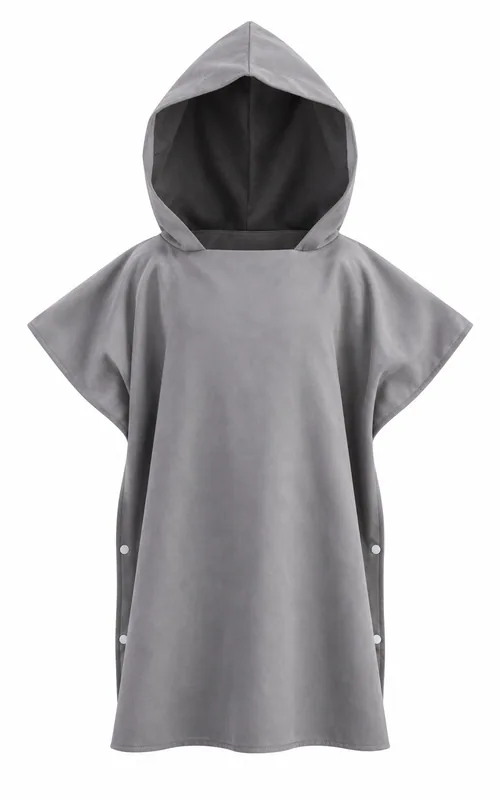
Kids' Ponchos and Beach Towels: A Sourcing Guide for Children's Ranges
Published: 2026-10-28 · Last updated: 2026-10-28
Short answer: children's ponchos and beach towels are the two easiest line extensions in a kids' beachwear range. Both carry lower minimums than garments, both sell to the same customer who already buys the swimwear, and together they turn a single swimsuit purchase into a complete beach set. The things that will catch you out are safety details on the poncho and print licensing on the towel.
Why kids' accessories outperform kids' swimwear on margin
A children's swimsuit is a fit-critical product: it needs graded sizing, a proper sample round, and usually several colourways. A poncho and a towel do not. They are essentially one-size accessories, which means:
- No grading. You approve one sample per design instead of a full size run.
- Lower minimums. 100 pcs per design for towels, 200 pcs for ponchos, against the same or higher for garment styles.
- Faster sampling. Less construction to get wrong.
- Higher perceived value. A parent buying a swimsuit will add a matching towel or poncho far more readily than a second swimsuit.
That combination is why accessories are usually the first thing a kids' brand adds after the core swimwear works.
Kids' ponchos: construction is a safety decision
An adult poncho is a convenience product. A children's poncho is a safety product, because of how it is used — a child pulling a garment over their head, often unsupervised, sometimes near water.
The three constructions, ranked by ease of use
| Construction | How a child puts it on | Considerations |
|---|---|---|
| Pull-over | Over the head | Simplest to make. Needs a generous neck opening so it does not catch. |
| Side-snap | Opens flat, wraps around, snaps at the side | Easiest for young children to manage alone, and no fabric over the face. |
| Front-opening | Opens down the front | Easiest of all, but adds closure hardware — check it is child-appropriate. |
For younger children, a side-snap or front-opening construction is generally the better choice: it avoids pulling fabric over the face and lets a child dress themselves.
Safety points to raise before you approve a sample
- Neck opening size. It must pass over the head easily without being loose enough to slip off during wear.
- Cords and drawcords. Drawcords at the neck are a known strangulation hazard in children's clothing. Many markets restrict or prohibit them. If you want a hood adjustment, discuss closures other than a loose neck cord.
- Small parts. Snap fasteners, pom-poms, tassels and decorative trims must be attached to a pull-test standard appropriate to the age group, because young children put things in their mouths.
- Flammability. Children's clothing may be subject to flammability requirements in your destination market. Confirm before production, not after.
- Hood lining. A lined hood sits better and is less likely to bunch over the face.
We raise these at sampling rather than assuming, and we can supply test reports for the materials used. Confirm the specific requirements of your destination market with your compliance advisor — the details vary by country and by age band.
Fabrics that work for children
- Waffle cotton — textured, breathable, absorbs well, and the texture hides marks. Popular in resort ranges.
- Microfibre — light, dries fast, packs small. The best choice for travel and for a towel-and-poncho matched set.
- Terry towelling — plush and warm after swimming, but heavy in a bag. Suits cooler climates and poolside rather than beach travel.
Avoid very heavy fabrics for young children: a wet, heavy poncho is uncomfortable and hard for a child to manage.
Kids' beach towels: where print licensing matters
Children's towels are almost always print-led — characters, animals, themes. That is exactly where the commercial risk sits, and it is worth being explicit about it.
The three print routes
| Route | What it means | Risk |
|---|---|---|
| Your own artwork | You supply original designs or commission them | Lowest — you own the rights |
| Public-domain / generic motifs | Dinosaurs, woodland animals, rainbows, waves as generic subject matter | Low, provided the specific drawing is original and not a copy of a protected character |
| Licensed characters | A known character or brand property | High — requires a licence; selling without one is infringement |
The distinction that catches brands out is between an idea and a specific expression. A dinosaur is a generic subject anyone can print. A particular cartoon dinosaur character is protected. The same applies to mermaids, unicorns and bears: the theme is free, the specific character design is not.
Before you approve a print, confirm that the artwork is original or properly licensed, and keep the record with the tech pack.
Size and weight for children
Children's towels are usually smaller and lighter than adult ones, because a child cannot carry a heavy wet towel and does not need the coverage.
| Age band | Typical size | Typical weight |
|---|---|---|
| Toddler | 60 × 120 cm | 200–250 gsm |
| Young child (approx. 3–7) | 70 × 140 cm | 250–300 gsm |
| Older child (approx. 8–12) | 80 × 160 cm | 250–300 gsm |
State the finished dimensions and a tolerance (±2 cm is typical) in the tech pack. Flat goods get measured, so agree the number rather than letting it be discovered on arrival.
MOQ: how the two products differ
This is the practical planning number:
| Product | MOQ | Why |
|---|---|---|
| Kids' beach towels | 100 pcs per design | No size grading, simpler construction, lower setup |
| Kids' ponchos | 200 pieces per style and color | Garment construction with hood, closures and fit approval |
Sampling runs 7–10 days per style, with bulk production 25–40 days after PP sample approval.
The implication for planning: a towel is the cheaper way to test a print direction, because you can commit to 100 pieces instead of 200. If you are unsure whether a dinosaur or a mermaid print will sell, test it on a towel first.
Building a coordinated kids' set
The strongest commercial play is to sell the pieces as a set, because the parent is buying for one child and one holiday:
- Match the print across towel and poncho. Same artwork, same colour family.
- Match the swimwear. If the child has matching swim shorts, the set becomes a complete beach outfit.
- Offer an adult version. Family sets — parent and child in the same print — sell particularly well to resort and holiday retail.
We produce the adult and children's versions from the same base fabrics, so a family set can run in one order with one approval cycle.
What to put in the tech pack
For a kids' poncho
- Construction type (pull-over, side-snap, front-opening) and closure specification
- Neck opening dimension, tested against the intended age band
- Finished body width, length and hood depth, with tolerance
- Any cord or trim — and confirmation it meets the destination market's rules
- Fabric, weight in gsm, and hood lining
- Care label and age-appropriate sizing label
For a kids' towel
- Finished dimensions and tolerance
- Weight in gsm
- Print artwork with a rights record (original or licensed)
- Print method (sublimation for full colour)
- Hem style and corner detail
- Care label and packaging
Common mistakes in children's beach accessories
- Scaling an adult product down. A child's poncho is not a small adult poncho — the neck opening, the closure and the weight all need to be reconsidered.
- Ignoring cord rules. Neck drawcords on children's garments are restricted in many markets. Check before you design one in.
- Assuming a print is generic. A generic theme is fine; a recognisable character is not, without a licence.
- Over-weighting the towel. A heavy towel is a wet, uncomfortable burden for a child.
- Forgetting the adult version. Family matching is the highest-value version of this range and costs almost nothing extra to develop.
- No pull-test on trims. Pom-poms and tassels look good and fail safety tests when they are not attached properly.
Styles in this range
These are the children's constructions we currently produce, if you want to see how each looks made up:
- Kids Side-Snap Hooded Changing Poncho — the easiest construction for a young child to manage alone.
- Kids Waffle Cotton Hooded Poncho — waffle texture with a hood and side fastening.
- Kids Pom-Pom Fringe Beach Poncho and Kids Wave-Panel Hooded Beach Poncho — the more decorative end of the range.
- Towels: dinosaur, unicorn rainbow, mermaid tail, woodland animal and embossed bear — note the last one is an embossed texture rather than a print, which avoids the licensing question entirely.
Summary
Children's ponchos and towels are the lowest-risk line extension in a kids' beachwear range: no grading, low minimums and the same customer. Design the poncho around how a child actually puts it on, keep cords and small parts within the destination market's rules, and make sure every print is either original or licensed. Then sell the pieces as a matched set — and add an adult version, because families buy them together.
Frequently Asked Questions
A side-snap or front-opening poncho is generally easier and safer for young children, because it avoids pulling fabric over the face and lets a child dress themselves. A pull-over needs a generously sized neck opening so it does not catch.
Neck drawcords on children's clothing are a known strangulation hazard and are restricted or prohibited in many markets. If you need a hood adjustment, discuss alternative closures rather than a loose neck cord, and confirm the rules for your destination market.
A generic theme such as a dinosaur or a mermaid is not protected, so original artwork on those subjects is fine. A specific recognisable character or brand property is protected and requires a licence. Keep a rights record for every print you approve.
Roughly 60 x 120 cm for toddlers, 70 x 140 cm for ages three to seven, and 80 x 160 cm for older children. Keep the weight at 250-300 gsm so a wet towel is not too heavy for a child to carry.
Kids' beach towels start at 100 pcs per design because there is no size grading and construction is simple. Kids' ponchos follow 200 pieces per style and color because they are garments requiring hood, closure and fit approval.
Ready to Produce Your Own Boardshorts?
Tell us your design, target market and quantity — we will help you plan production with flexible MOQ.
Get a Free Quote