Custom Beach Towels with Logo: Bulk Ordering Guide
Published: 2026-10-31 · Last updated: 2026-10-31
Short answer: a branded beach towel is one of the few promotional products people keep and use repeatedly, which is why hotels, resorts, swim schools and corporate buyers order them in bulk. The three decisions are the logo method, the quantity tier and the artwork specification — and the logo method is the one that most often goes wrong.
Three ways to put a logo on a towel
| Method | Result | Best for | Limits |
|---|---|---|---|
| Sublimation print | Full colour, edge to edge, becomes part of the fabric | Graphic logos, photographic artwork, full-bleed designs | Polyester only; no hand-feel penalty but limited to microfibre |
| Embroidery | Raised thread, premium and tactile | Hotel and resort monograms, crests, simple marks | Small areas only; cost rises with stitch count |
| Woven label / patch | Separate label sewn on | Brand marks on cotton terry, where printing is impractical | Adds a sewing step; limited to small rectangular areas |
The practical rule: microfibre prints, cotton terry embroiders. If your artwork is a full-colour graphic, sublimation is the only method that reproduces it properly. If it is a single-colour crest and the towel is terry, embroidery reads more premium.
Why sublimation is the default for microfibre
Dye is converted to gas and bonded into the polyester fibres, so the print becomes part of the cloth rather than a layer sitting on top. That means:
- No cracked or peeling print after washing, because there is no ink film.
- No hand-feel penalty — you cannot feel where the logo is.
- Unlimited colours at no extra cost, unlike screen printing where each colour adds a screen.
- Full-bleed coverage — the design can run to the hem on all four sides.
The constraint is the fabric: sublimation only bonds to polyester-dominant cloth. On cotton terry it will not work.
Quantity tiers and what changes at each
Branded towel orders fall into three rough bands, and the cost structure changes at each one.
| Quantity | Typical buyer | What changes |
|---|---|---|
| 100–250 pcs | Small hotel, swim school, single-location business | One design, one size, standard hem. Our minimum is 100 pcs per design. |
| 250–1,000 pcs | Resort group, corporate gifting programme | Better unit price; multiple colourways become viable |
| 1,000+ pcs | Hotel chain, distributor, promotional agency | Custom dimensions and custom packaging become economical |
Our minimum is 100 pcs per design, which is lower than most garment categories because a towel has no size grading — one pattern, one cut. That makes a towel the cheapest way to test a branded concept before committing to a full apparel range.
What drives the unit price
- Weight (gsm). The single biggest lever. 250–300 gsm is the volume band; 300–400 gsm costs more and dries slower.
- Size. Fabric is sold by the metre, so a 100×180 cm towel uses substantially more than a 70×140 cm one.
- Logo method. Sublimation is priced into the print run; embroidery is priced by stitch count and is usually the most expensive per unit.
- Quantity. Setup cost is fixed, so unit price falls with volume.
- Finishing. Bound edges, rounded corners and custom packaging each add a step.
Artwork: what to send
Most logo delays are artwork delays. Send these up front:
- Vector file (AI, EPS, PDF or SVG) where possible. Raster artwork needs to be at least 300 dpi at final print size.
- Pantone references for every colour, not RGB values — screen colour and fabric colour are different.
- Placement and size in centimetres, with a diagram if the position matters.
- Repeat or single placement — a single centred logo and an all-over repeating pattern are different print setups.
If you only have a low-resolution logo from a website, tell us — we can usually redraw a simple mark, but it adds a step and should be agreed before the quote.
Sampling a branded towel
Sampling takes 7–10 days per design. For a branded towel the sample matters more than usual, because it is the only way to confirm:
- that the Pantone reference matches on the actual fabric,
- that the logo size reads correctly at the finished dimensions,
- that the print is centred and not distorted at the edges,
- that the weight and hand-feel match what you are selling.
Approve a physical sample, not a screen proof. Colour on-screen and colour on microfibre are not the same thing.
Bulk production and lead time
Bulk production runs 25–40 days after PP sample approval and confirmation of all details. Two things affect your timeline:
- Artwork approval. Every day spent revising the file is a day added to the schedule.
- Peak season. Beach towel demand peaks in spring. Orders placed for Q2 delivery should be confirmed well before the season starts.
Where branded beach towels sell
| Buyer | What they want | Typical order |
|---|---|---|
| Hotels & resorts | Durable, uniform, embroidered crest, often a specific size for loungers | 200–1,000 pcs, repeat annually |
| Swim schools | Bright colours, printed logo, quick-dry for daily use | 100–300 pcs |
| Corporate gifting | Premium feel, presentation packaging, brand-consistent colour | 100–500 pcs |
| Beach clubs & bars | Bold print, often sold or lent to guests | 150–500 pcs |
| Retail brands | Full-colour graphic, retail packaging, matched to a swimwear range | 100–500 pcs per design |
Common mistakes with branded towels
- Printing on the wrong fabric. Sublimation does not work on cotton terry — the artwork will fail before production starts.
- Approving a screen proof. Screen colour and fabric colour differ. Always approve a physical sample.
- Ignoring shrinkage. If the base contains cotton, allow for it, or the finished towel arrives smaller than specified.
- Ordering labels and packaging late. They have their own lead time and can hold up a finished order.
- Undersizing the logo. A mark sized for a business card disappears on a 90×170 cm towel.
- Forgetting the care label. Required for retail, and easy to leave out of a first quote.
Towels we produce
Our microfiber beach towels run from 100 pcs per design and cover the common print directions:
- Adult Wide Stripe Microfiber Beach Towel — broad horizontal stripes, the classic volume style
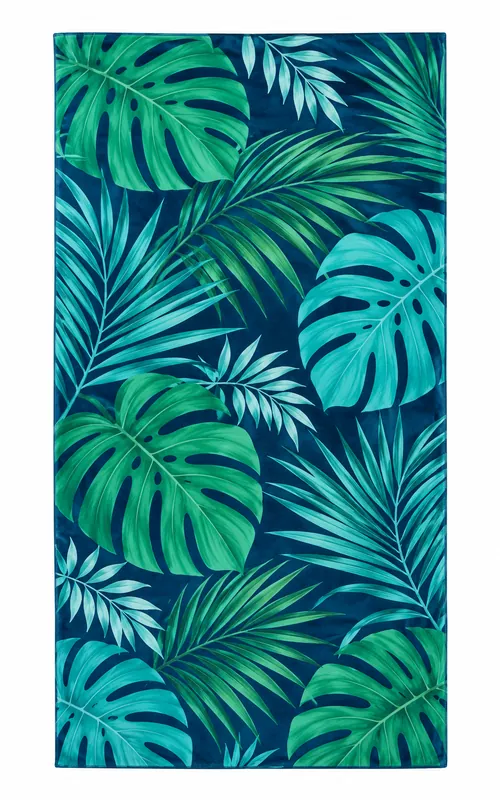
- Adult Tropical Leaf Microfiber Beach Towel — all-over leaf print
- Adult Geometric Microfiber Beach Towel — graphic geometric direction
- Adult Sunset Palm Microfiber Beach Towel — gradient palm print
- Adult Pink Stripe Microfiber Beach Towel — fine stripe, retail-friendly palette
- Kids: dinosaur, unicorn rainbow, mermaid tail, woodland animal, embossed bear
For the full technical breakdown see the microfiber beach towel guide, and for quantity planning see beachwear MOQ explained.
Summary
Choose sublimation for microfibre and embroidery for cotton terry. Send vector artwork with Pantone references and a placement diagram. Approve a physical sample rather than a screen proof. Start at 100 pieces per design, and confirm before the spring peak if you need delivery in season.
Frequently Asked Questions
Sublimation print for microfiber towels, because it reproduces full-colour artwork and becomes part of the fabric. For cotton terry, embroidery reads more premium and works better. Woven labels are the third option for small brand marks.
100 pcs per design. Towels sit lower than garment categories because there is no size grading - one pattern, one cut.
Not with sublimation, which only bonds to polyester-dominant fabric. On cotton terry the practical options are solid dyes, yarn-dyed stripes, jacquard or embroidery.
Sampling takes 7–10 days per design and bulk production runs 25–40 days after PP sample approval. Artwork approval time adds to that schedule, so send files early.
A physical sample. Screen colour and fabric colour differ, and only a physical sample confirms the Pantone match, the logo size at finished dimensions, and whether the print is centred.
Ready to Produce Your Own Boardshorts?
Tell us your design, target market and quantity — we will help you plan production with flexible MOQ.
Get a Free Quote