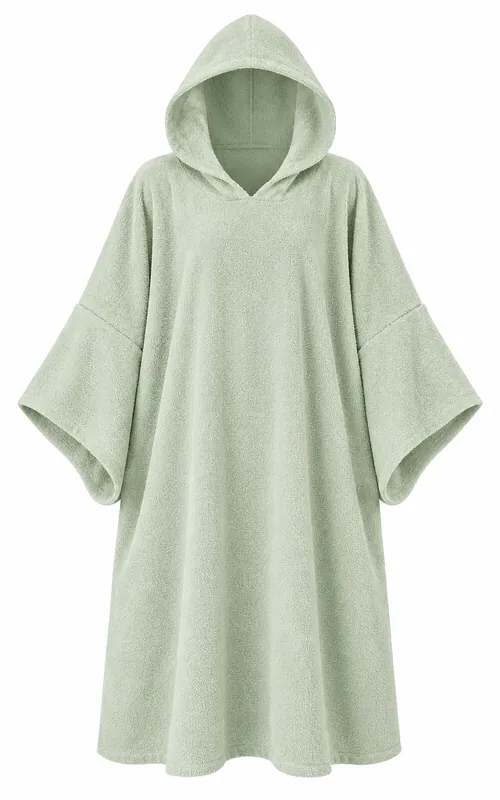
Surf Poncho Buying Guide: Microfibre vs Cotton, Hood vs No Hood
Published: 2026-10-31 · Last updated: 2026-10-31
Short answer: buy microfibre for print-led surf and travel ranges, cotton terry for resort and spa positioning. Always take a hood. Take a side-snap or front-opening closure if children or older adults will wear it. Everything else — size, weight, trim — follows from those three decisions.
The five specification decisions
| Decision | Options | What it changes |
|---|---|---|
| Fabric | Microfibre / cotton terry / waffle cotton | Drying speed, print method, weight, price point |
| Hood | Hooded / hoodless | Warmth, drying of hair, cost, the silhouette itself |
| Closure | Pull-over / side-snap / front-opening | Ease of use, safety, unit cost |
| Weight | 200–400 gsm | Absorbency, packability, cost |
| Trim | Plain hem / contrast binding / fringe / pom-pom | Perceived quality, cost, age suitability |
Microfibre vs cotton terry
Microfibre
- Weight: typically 200–300 gsm — folds down to roughly the size of a paperback.
- Drying: several times faster than cotton, and stays soft without fabric softener.
- Print: takes full-bleed sublimation print, which is why it dominates graphic-led surf ranges.
- Hand-feel: thinner, more technical. Reads as performance gear.
- Limitation: on a premium price point, thin unlined microfibre can feel cheap if the hood is not lined.
Cotton terry
- Weight: commonly 300–400 gsm or higher — plush and substantial.
- Drying: slower, and heavy in a suitcase.
- Print: solid dyes, yarn-dyed stripes, jacquard or embroidery. Full-colour photographic print is not practical on looped terry pile.
- Hand-feel: hotel-spa and resort positioning, which supports a higher retail price.
- Limitation: shrinkage. Allow for it in the specification or the finished garment arrives smaller than approved.
Waffle cotton — the middle option
Waffle weave sits between the two: lighter than terry, more textured than microfibre, and it looks considered on a resort shop rail. It absorbs well, dries faster than terry, and the texture hides marks — which is why it is popular for children's ponchos.
Hood or no hood
Take the hood. It is the reason the product exists as a changing garment rather than a towel you hold up:
- Warmth after swimming — wet hair and a cool breeze is the scenario a poncho solves.
- It covers while you change — the hood gives the head coverage a flat towel cannot.
- It defines the silhouette — a hoodless changing poncho reads as a towel with a hole in it.
Where a hoodless version makes sense: very lightweight travel ponchos where packability outranks everything, and some spa or sauna contexts where a clean line matters more than warmth.
If you do specify a hood, line it. An unlined hood in thin microfibre is the fastest way to make an otherwise good product look cheap.
Closure: the decision that affects safety
| Closure | How it is worn | Who it suits | Trade-off |
|---|---|---|---|
| Pull-over | Over the head | Adults, price-led ranges | Cheapest; needs a generous neck opening |
| Side-snap | Opens flat, wraps, snaps at the side | Children; anyone wanting to avoid fabric over the face | Adds snaps and a step |
| Front-opening | Opens down the front | Older adults, limited mobility | Zip or magnetic closure; highest unit cost |
For children's ponchos, side-snap or front-opening is generally the better choice: no fabric over the face and the child can dress themselves. See the kids' poncho and towel guide for the safety points — particularly the restriction on neck drawcords in many markets.
Weight and size
There is no standardised size, which is why every poncho brief should state finished dimensions and a tolerance.
| Type | Typical body width | Typical length | Weight |
|---|---|---|---|
| Adult standard | 90–100 cm | 105–115 cm | 250–300 gsm |
| Adult oversized | 110–120 cm | 115–125 cm | 300–400 gsm |
| Kids | 60–70 cm | 60–80 cm | 200–250 gsm |
Two specification traps: measure the arm opening diameter against a real body (too small and it will not go over the shoulders), and state the tolerance (±1–2 cm is typical).
Trim and finishing
- Plain hem — cheapest, and fine on a performance microfibre piece.
- Contrast binding — costs more, reads as a finished premium product, and defines the silhouette.
- Fringe — resort and festival positioning; adds a trimming step and a pull-test requirement for children's sizes.
- Pom-pom — kids' gifting; must pass small-parts pull tests.
- Pocket — a front pocket turns the poncho into something wearable beyond the beach.
Specification by market
| Positioning | Fabric | Closure | |
|---|---|---|---|
| Surf / performance | Microfibre 250–300 gsm | Pull-over | Full-bleed sublimation |
| Resort / spa | Cotton terry 350–400 gsm | Pull-over or front-opening | Solid dye, jacquard or embroidery |
| Travel | Microfibre 200–250 gsm | Pull-over, hoodless | Simple placement print |
| Kids | Waffle cotton or microfibre 200–250 gsm | Side-snap | All-over print |
| Premium / gift | Heavy terry with contrast binding | Front-opening | Embroidery or jacquard |
What to put in the tech pack
- Fabric type, composition and weight in gsm
- Finished body width, body length and hood depth, with tolerance
- Arm opening diameter and position
- Closure type and hardware specification
- Hood lining (single layer or lined)
- Hem finish, binding width and trim specification
- Print placement, artwork file and Pantone references
- Care label content and languages
MOQ and lead time
Ponchos follow the standard garment minimum of 200 pieces per style and color per design and colour, because they are garments requiring hood, closure and fit approval. Sampling takes 7–10 days and bulk production runs 25–40 days after PP sample approval.
If 200 pieces per design is above your planned buy, concentrate the order into fewer colourways rather than fewer pieces — the fixed cost is per design and colour, not per piece.
Ponchos we produce
- V-Panel Hooded Surf Poncho — the simplest pull-over construction
- Diagonal Colour-Block Hooded Changing Poncho — hood plus front pocket
- Contrast Pocket Hooded Beach Poncho — contrast detailing
- Contrast Binding Hooded Beach Poncho — bound edges, premium finish
- Oversized Microfibre Beach Changing Poncho — roomier adult cut
- Three-Quarter Sleeve Hooded Changing Poncho — longer sleeves
- Convertible Cotton Poncho Beach Towel — works as both
- Family Striped Fringe Cotton Poncho — adult and child version
For the category overview, see custom surf ponchos: a buyer's guide.
Summary
Microfibre for print and travel, terry for resort and premium, waffle for kids. Take the hood and line it. Choose side-snap or front-opening if children or older adults will wear it. Specify finished dimensions with a tolerance, and measure the arm opening against a real body. Then approve the sample on a person, not a form.
Frequently Asked Questions
Microfibre for print-led surf and travel ranges because it dries fast and takes full-bleed sublimation print. Cotton terry for resort and spa positioning because it feels plush and supports a higher price, though it dries more slowly.
Yes, in almost all cases. The hood provides warmth after swimming, gives head coverage while changing, and defines the garment's silhouette. If you specify a hood, line it - an unlined hood in thin microfibre looks cheap.
Pull-over is cheapest and suits adult price-led ranges. Side-snap is better for children because no fabric goes over the face and they can dress themselves. Front-opening suits older adults or limited mobility, at higher unit cost.
Around 90-100 cm body width and 105-115 cm length for a standard adult cut, or 110-120 cm wide for an oversized version. Always state a tolerance, typically plus or minus 1-2 cm, and specify the arm opening diameter.
MOQ is 200 pieces per style and color per design and colour, sampling takes 7–10 days, and bulk production runs 25–40 days after PP sample approval.
Ready to Produce Your Own Boardshorts?
Tell us your design, target market and quantity — we will help you plan production with flexible MOQ.
Get a Free Quote