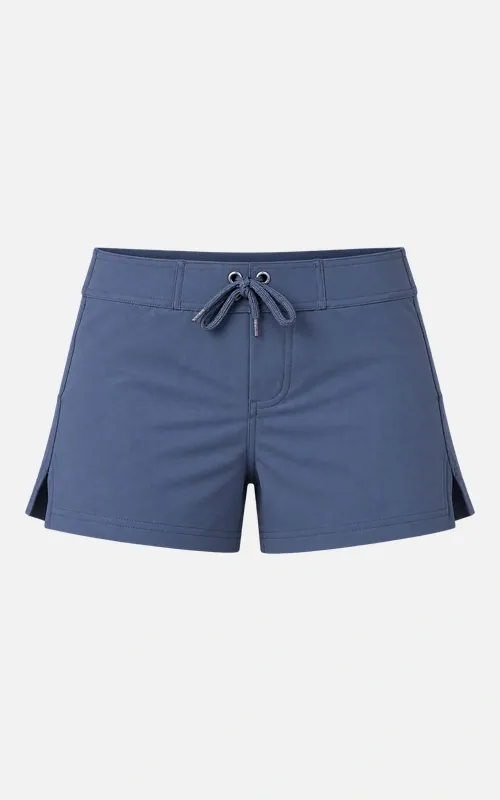
Women's Boardshorts: Fit, Waist and Styling Guide for Brands
Published: 2026-10-29 · Last updated: 2026-10-29
Short answer: women's boardshorts are not a scaled-down men's pattern. Four decisions drive whether the style sells — the waist construction (elastic, fixed, tie-front or fold-over), the inseam length, the rise, and whether the leg is straight or flared. Get those right and the rest is print and colour.
Why women's boardshorts behave differently from men's
A men's boardshort is usually bought to swim or surf in. A women's pair is often bought to wear — over swimwear on the beach, with a top for lunch, as a cover-up that doubles as clothing. That changes the design brief:
- Drape matters more than performance. A stiff, technical hand-feel reads as men's product.
- The waist is the style decision. On a men's short the waist is functional; on a women's short it is the feature the customer sees first.
- Length is a fashion choice, not a coverage formula. Short, mid and longer lengths all sell, but in different accounts.
- Fabric usually carries stretch. Four-way stretch is close to standard, because the garment is worn as clothing as well as swimwear.
The four waist constructions
| Construction | How it looks | Best for |
|---|---|---|
| Gathered elastic | Soft, ruched waistband with a drawcord | Relaxed, comfortable resort pieces; the easiest fit to grade |
| Fixed flat waist | Smooth, tailored waistband, often with a zip or button | More polished, swimwear-as-clothing positioning |
| Tie-front | Adjustable tie at the centre front | Fashion-led ranges; the tie is the design feature |
| Fold-over | Waistband folds down over the hip | Low-rise, beachwear styling; can also be worn higher |
Each one changes what you need in the tech pack. Elastic and fold-over waists are the most forgiving to grade; a fixed flat waist needs a proper size run and usually a fitting on a real body before you approve the sample.
Elastic waist
The safest commercial choice. It accommodates a range of bodies, tolerates grading errors better than a fixed waist, and is the cheapest to manufacture. The trade-off is that it reads as casual rather than tailored.
Fixed flat waist
This is the one that makes a boardshort look like a short rather than a swim garment. It needs a real pattern and a graded size run, and it is less forgiving if your size chart is wrong. Expect a higher sample cost and at least one fitting round.
Tie-front
The tie becomes the focal point, so the waistband itself can stay simple. Watch the cord specification: length, tip finish and whether it is functional or decorative all change the look and the cost.
Fold-over
Popular in beachwear because it can be worn at two heights. Specify both the folded and unfolded finished measurements, or the fit will be inconsistent between production runs.
Inseam length: the second biggest decision
| Inseam | Character | Typical market |
|---|---|---|
| 4–5 cm / 1.5–2" | Very short, cheeky | Fashion, festival, younger customers |
| 7–9 cm / 3–3.5" | Short but wearable | The volume sweet spot for beachwear |
| 10–13 cm / 4–5" | Mid-length, closest to a men's cut | Surf, swim-sport, more conservative accounts |
State the inseam as a finished measurement from the crotch seam, not as an overall length. The two are easily confused, and the difference is large enough to ruin a sample.
Rise and leg shape
Rise — the distance from crotch seam to waistband — determines whether the short sits at the hip, the natural waist, or above it. High-rise has been the dominant direction in womenswear for several seasons, and it pairs naturally with a fold-over or fixed flat waist. Low-rise suits the beachwear market and fold-over constructions.
Leg shape is usually a choice between straight and slightly flared. A flared leg reads softer and more resort; a straight leg reads sportier. Whichever you choose, specify it in the tech pack with a measurement at the hem — “straight leg” alone is not enough for a pattern maker to reproduce your reference.
Fabric and lining
- Stretch: four-way is close to standard. Two-way works for looser, non-fitted styles.
- Weight: lighter than men's boardshort fabric in most cases — a women's short is often worn as clothing, so drape beats durability.
- Lining: many women's styles are unlined, because they are worn over swimwear. Decide this early: a lined and an unlined version are different garments with different costs.
- Hand-feel: if the fabric feels like men's boardshort cloth, the garment will read as men's product regardless of the cut.
What to put in the tech pack
- Waist construction, and for tie-front or fold-over, the cord and fold specifications
- Inseam as a finished measurement from the crotch seam
- Rise, and where the waistband sits on the body
- Hem width, so the leg shape is reproducible
- Lined or unlined, and the lining specification if lined
- Fabric composition, weight and stretch direction
- Graded size chart, with the grade rule stated (not just a table of numbers)
- Pocket specification — whether they are functional or decorative
Common mistakes
- Scaling a men's pattern down. The rise, hip curve and leg opening all need rebuilding, not shrinking.
- Specifying overall length instead of inseam. The single most common source of a wrong sample.
- Using men's boardshort fabric. It gives a stiff, technical garment that will not sell as womenswear.
- Skipping a fitting on a real body. Fixed waists and high rises in particular need one.
- Not stating the grade rule. A size chart without the grade rule cannot be extended to a new size.
- Forgetting that the garment is worn as clothing. If it only works as swimwear, the customer buys it once.
- Women's Blue Elastic Waist Beach Shorts — gathered elastic waist, the most forgiving fit to grade.
- Women's Indigo Tie Front Boardshorts — fixed flat waist with a tonal tie front.
- Women's Sunset Stripe Lace Up Boardshorts — lace-up front and stripe bands.
- Women's Navy Floral Panel Boardshorts — floral side panels with a front lace-up.
- Women's Tropical Fold Over Waist Beach Shorts — fold-over waist for two wearing heights.
Styles in this range
These are the women's constructions we currently produce, covering all four waist types:
For the men's and kids' equivalents, see the men's boardshort styles guide and the kids' beachwear guide.
Summary
Treat women's boardshorts as womenswear that happens to be swim-safe, not as swimwear in a female size. Pick the waist construction first, then the inseam, then the rise and leg shape. Specify the inseam from the crotch seam, state the grade rule alongside the size chart, and use a fabric that drapes. That is what separates a style that sells once from one that reorders.
Frequently Asked Questions
An elastic or gathered waist is the easiest to grade and the safest commercial choice. A fixed flat waist looks more tailored but needs a proper graded size run and at least one fitting. Tie-front and fold-over waists make the waist itself the design feature.
Seven to nine centimetres is the volume sweet spot for beachwear. Four to five centimetres suits fashion-led ranges, and ten to thirteen centimetres is closest to a men's cut for surf and swim-sport accounts.
Often not, because they are usually worn over swimwear. Decide early, though: a lined and an unlined version are different garments with different costs and different pattern requirements.
State the inseam as a finished measurement from the crotch seam, not as an overall length. Confusing the two is the most common reason a sample comes back the wrong length.
It follows the standard garment minimum of 200 pieces per style and color, with sampling in 7–10 days and bulk production in 25–40 days after PP sample approval.
Ready to Produce Your Own Boardshorts?
Tell us your design, target market and quantity — we will help you plan production with flexible MOQ.
Get a Free Quote